The 2026 Kitchen Revolution: Smart, Snackable, and Sustainable – But At What
The 2026 Kitchen Revolution: Smart, Snackable, and Sustainable – But At What Cost?
The global kitchen industry is entering a phase of unprecedented transformation. By 2026, three macro forces—smart technology, snacking culture, and sustainability—will converge to reshape how consumers cook, eat, and interact with their kitchens. The complete kitchen market is projected to grow at a compound annual growth rate (CAGR) of 10.5% from 2026 to 2033, with Asia-Pacific alone capturing 35% of global market share. Yet beneath the surface of this expansion lies a tension: consumer curiosity is high, but trust in innovation remains fragile. Retailers are gaining power, private labels now command 44% of the European market, and profitability constraints are squeezing genuine breakthroughs. This article examines the real dynamics behind the kitchen industry trends 2026, exploring how snackification, AI perception, and retailer dominance will redefine brands and supply chains.
[IMAGE: Infographic showing three pillars (smart, sustainable, compact) with trend arrows and regional market share pie chart.]
Smart Kitchen Appetite: High Search, Low Trust
Consumer interest in smart kitchen appliances has never been sharper. Google search interest for the term “smart kitchen appliances” surged from a baseline of negligible to a peak of 94 in April 2026—a clear signal that households are curious about connected cooking. Major players such as Haier, Midea, and Vatti have responded with new product lines, embedding Wi-Fi, voice control, and recipe recommendation engines into ovens, refrigerators, and countertops.
Yet the enthusiasm stops at the search bar. According to global consumer sentiment surveys, only 36% of individuals hold a positive perception of artificial intelligence in their daily lives; the majority remain skeptical, indifferent, or actively distrustful. This gap between curiosity and adoption poses a fundamental challenge for the smart kitchen appliances segment. McKinsey research notes that even as manufacturers invest in R&D, immediate profitability pressures force them to prioritize cost-cutting over radical innovation. The result: smart features become commoditized add-ons rather than transformative experiences.
The implication is clear. While smart functionality will become standard in mid-range and premium kitchen products by 2026, mass adoption will lag until AI earns consumer trust through transparency, reliability, and demonstrable utility. Brands that can explain what their algorithms actually do—and why they matter—will separate themselves from the noise.
[IMAGE: Line graph of Google search interest for “smart kitchen appliances” from April 2025 to April 2026, with annotation of the peak at 94.]
Sustainable Materials: Niche Interest, Unmet Demand
Sustainability in the kitchen has followed a different pattern: intermittent peaks driven by events, rather than sustained demand. Search interest for “sustainable kitchen materials” reached 25 in March 2026, but then receded. In contrast, the search volume for “kitchen design innovations” remained near zero throughout 2025–2026, peaking at only 2. This disparity reveals a critical insight: consumers want sustainable products, but they do not associate sustainability with design innovation. The two are seen as separate conversations.
Meanwhile, a more concrete driver is emerging: food allergies. With 2.4 million adults in the U.S. alone requiring strict allergen avoidance, demand for transparent, traceable materials is rising. Kitchen surfaces, storage systems, and packaging must now accommodate labeling that communicates both sustainable sourcing and allergen safety. This dual requirement places pressure on material suppliers to provide certified, recyclable composites that do not compromise on durability or aesthetics.
However, Europe’s cautious consumer spending—France’s net balance indicator sits at -33 points—may slow the adoption of premium sustainable materials. Private label growth, now at 44% of European grocery and household goods sales, could accelerate cost-effective green alternatives. Retailers are beginning to offer own-brand sustainable kitchen tools at lower price points, making eco-friendly choices accessible to price-sensitive households. The sustainable kitchen materials segment will likely grow, but via mass-market retail channels rather than high-end boutique offerings.
[IMAGE: Split image: left shows a countertop made of recycled composite, right shows a label with allergen and sustainability certifications.]
Snackification & Compact Living: Redefining Kitchen Functions
Perhaps the most profound shift in the 2026 kitchen is functional: the kitchen is no longer primarily a cooking room. Snackification—the replacement of full meals with smaller, frequent eating occasions—has become mainstream. According to recent consumer data, 57% of consumers regularly replace at least one full meal per day with snacks. This behavior is reshaping kitchen design from the ground up.
Compact islands, modular shelving, and countertop spaces optimized for quick assembly rather than extended preparation are in high demand. Refrigerators are being redesigned with multiple small compartments for grab-and-go items. Microwave drawers, air fryers, and induction hobs that double as warmers are standard features in kitchen industry trends 2026. The kitchen is becoming a snack-friendly hub, not a cooking station.
This trend is particularly pronounced in Asia-Pacific, where urban living spaces are shrinking and convenience is paramount. The region’s 35% share of the global kitchen market is driven by rapid urbanization, rising disposable incomes, and a cultural preference for small, frequent eating. Brands that can deliver compact, multi-functional appliances for snacking will lead growth.
Yet the snackification wave also carries cost implications. Smaller appliances require less material and energy, which aligns with sustainability goals, but they also reduce the average selling price per unit. Manufacturers must balance volume growth with margin preservation. For retailers, the opportunity lies in cross-selling snack-related accessories—storage containers, portion-control tools, and cleaning products—that accompany the snack habit.
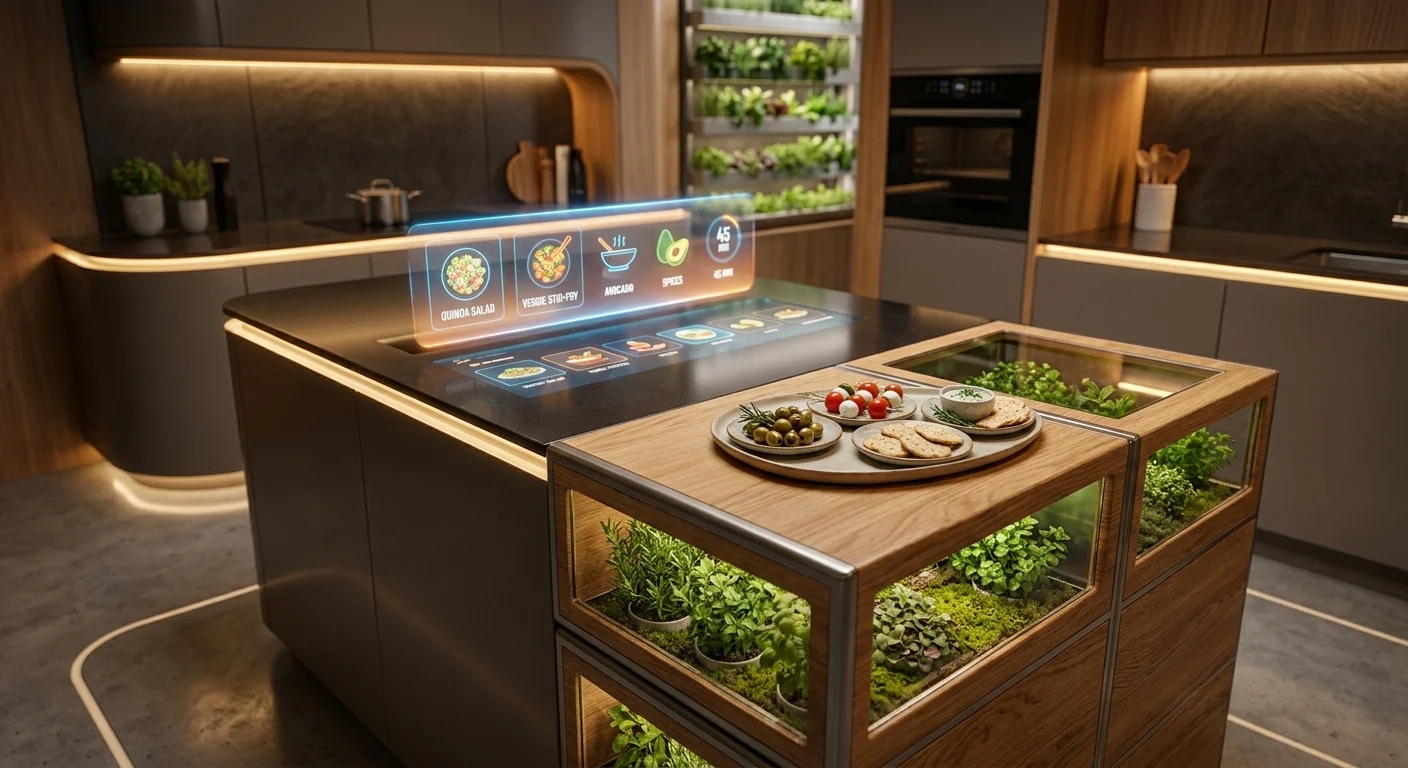
[IMAGE: Photograph of a modern compact kitchen island with pull-out drawers for snacks, a built-in air fryer, and small plates arranged for a quick meal.]
Retailer Power Shift: Private Labels Reshape Brand Dynamics
While the three macro trends garner attention, the underlying structural change in the kitchen market may be the most consequential. Private label share has jumped to 44% in Europe, and similar growth is evident in the U.S. among major retailers like Walmart, Target, and Costco. These retailers are no longer passive distributors; they are data-driven powerhouses that use point-of-sale information to dictate product specifications, packaging, and pricing to suppliers.
This retailer power shift directly impacts smart kitchen appliance manufacturers. A retailer that controls shelf space can demand proprietary features that lock consumers into its ecosystem—such as private-label smart refrigerators that only work with the retailer’s own app. For traditional brand owners, this creates a dilemma: invest in brand differentiation that retailers may undermine, or accept margin compression to secure distribution.
The tension is most visible in the premium tier. High-end European appliance brands like Miele and Gaggenau still command loyalty, but their market share is shrinking as mid-range private labels improve quality. In the sustainable materials segment, retailer-driven private labels may accelerate adoption of green options faster than any independent brand could. The question is whether cost-driven sustainability will be perceived as greenwashing or genuine progress.
The Innovation Bottleneck: Profitability Over Breakthrough
Across all three pillars—smart, sustainable, snackable—the same obstacle emerges: short-term profitability constraints stifle true breakthroughs. A McKinsey survey of kitchen industry executives reveals that 68% prioritize cost reduction over new product development, a figure that rises to 82% among mid-market manufacturers. The result is incremental innovation: slightly smaller fridges, slightly more energy-efficient ovens, slightly smarter voice assistants—but no radical leaps.
The consumer perception gap reinforces this. As long as AI trust remains low, manufacturers will hesitate to invest in advanced features that consumers may reject. Similarly, the near-zero search interest in kitchen design innovations suggests that consumers do not reward aesthetic risk-taking. They want functional improvements, not form innovations.
This creates a paradox: the kitchen market is growing at 10.5% CAGR, yet the innovation pipeline is clogged by risk aversion. The only way to break the bottleneck is for retailers and manufacturers to collaborate on shared R&D, or for a disruptive entrant—perhaps a tech company—to redefine the category from outside. So far, no such disruptor has emerged.
Conclusion: A Market of Contradictions
The complete kitchen market of 2026 is a study in contradictions. Consumer search interest for smart technology is sky-high, but trust is low. Sustainability demand is rising but fragmented. Snackification is reshaping kitchen functions, yet design innovation remains stagnant. Retailers are gaining unprecedented power while manufacturers struggle to maintain margins. Asia-Pacific leads growth, but Europe and the U.S. focus on private labels and data-driven retail.
For industry participants, the path forward requires navigating these tensions. Smart features must be accompanied by transparent AI communication. Sustainable materials must be affordable and practical, not aspirational. Snackable kitchen designs must balance convenience with durability. Above all, the industry must recognize that the kitchen is evolving from a cooking room to a data-driven, snack-friendly hub—and that evolution will not be smooth. The cost of the revolution is measured not only in dollars, but in consumer trust, innovation courage, and the willingness to abandon old models. The winners will be those who embrace the contradictions rather than ignore them.