The Great Food Reset: How Private Label and Clean-Label Are Redefining the
The Great Food Reset: How Private Label and Clean-Label Are Redefining the $9.79 Trillion Market by 2026
The global food industry is in the midst of a structural transformation that few predicted with such speed. In the first half of 2025, private label products captured an all-time high of 21.2% of dollar share and 23.2% of unit share in the United States alone. At the same time, the clean-label ingredient market has swelled to $57.3 billion, growing at a compound annual rate of 15.5%. These two seemingly opposite forces—value-seeking and premium transparency—are converging to rewrite the rules for the $9.79 trillion global food market. By 2026, the industry will look fundamentally different, shaped by the tension between affordability and trust, convenience and health, scale and authenticity.
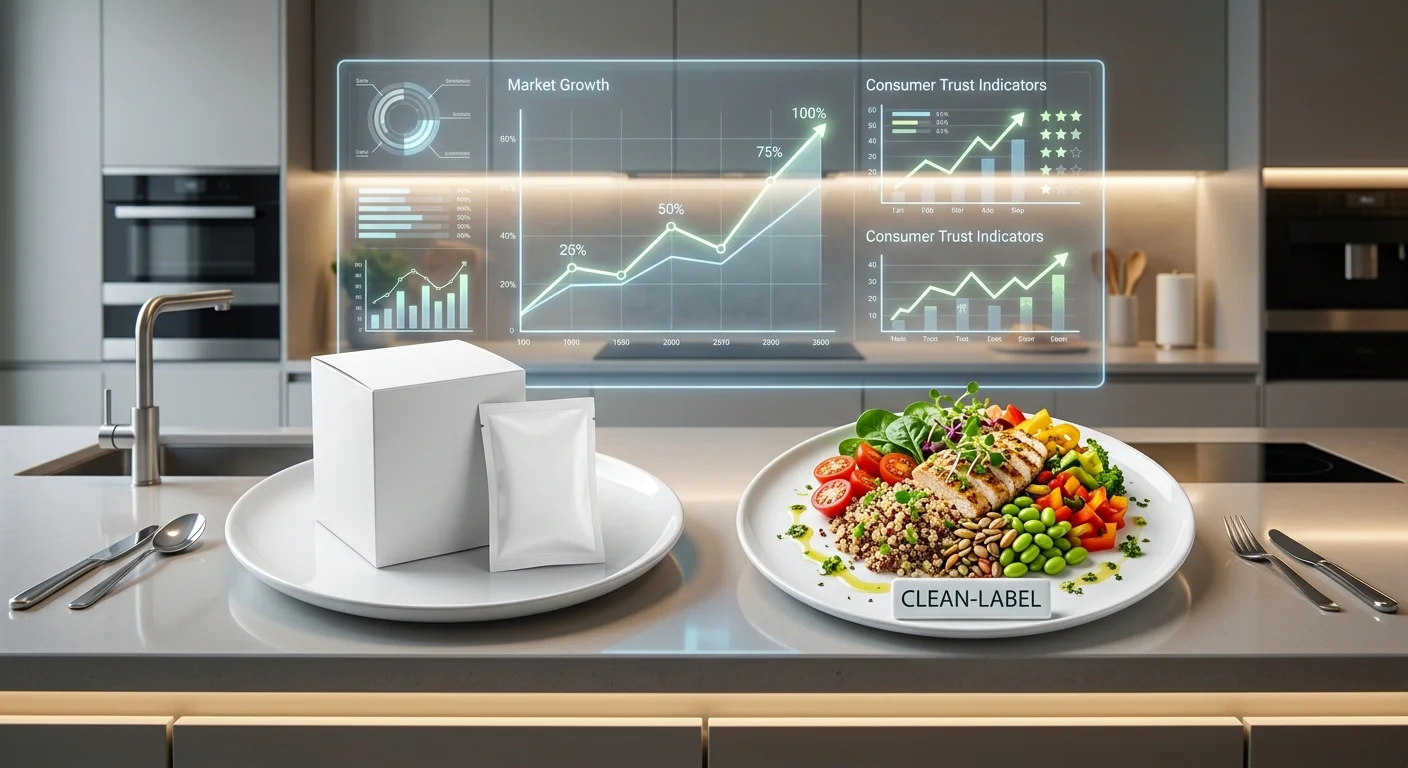
[IMAGE: A futuristic kitchen counter with two contrasting plates: one with a simple, minimalist private label product (white packaging) and another with a vibrant, natural ingredient dish labeled 'clean-label'. In the background, a transparent digital display shows data graphs of market growth and consumer trust indicators. No text, no watermark. Photorealistic, high detail.]
The Quiet Revolution: Private Label's Ascent and What It Means
Private label has long been viewed as a recession-driven fallback—something consumers buy when money is tight and abandon when the economy improves. But the data tells a different story. In H1 2025, private label dollar sales grew 4.4% compared to a meager 1.1% growth for national brands. Meanwhile, unit sales of national brands actually declined 0.6%, signaling that consumers are not merely “trading down” out of necessity but actively shifting their loyalties while expecting quality.
This is a structural shift, not a pandemic blip. Projected private label sales for 2025 will reach $277 billion, surpassing 2024’s record of $271 billion. The momentum is accelerating. Retailers have invested heavily in product innovation, packaging design, and supply chain efficiency. Store brands are no longer generic facsimiles; they are becoming trusted product innovators that offer comparable or superior quality at a lower price point.
The implication is profound: national brands can no longer rely on brand heritage alone. They must rethink their value proposition—either by justifying a price premium through demonstrable differentiation or by innovating in areas where private label struggles, such as unique health claims, patented ingredients, or experiential marketing.
[IMAGE: A supermarket aisle with prominent store-brand products and a line chart showing private label share growth over years. Photorealistic, bright lighting.]
Clean-Label Premium: The $57 Billion Trust Tax
While private label pressures margins, a parallel trend is pushing prices upward: the clean-label movement. According to recent consumer surveys, 75% of shoppers are willing to pay a premium for products without synthetic additives. This willingness is the bedrock of the clean-label market, valued at $57.3 billion and growing at a 15.5% CAGR—more than four times the overall food market growth rate (~3.8% implied from $9.79 trillion to $11.78 trillion over five years).
Clean-label is no longer niche; it is a mainstream license to operate. Consumers demand ingredient lists they can read and pronounce, with no artificial colors, flavors, preservatives, or genetically modified organisms. For manufacturers, reformulating products to meet these standards adds cost—replacing cheap stabilizers with natural alternatives, sourcing organic or non-GMO raw materials, and investing in certification processes.
The critical tension arises when value-seeking consumers—the same ones driving private label growth—also expect transparency. This creates a dual market. On one hand, there is premium clean-label, sold at a higher price point by brands that emphasize heritage, sourcing stories, and certified organic claims. On the other hand, a new category of value clean-label is emerging, where private label retailers deliver affordable products that meet basic clean-label thresholds without the premium price tag. Each requires a different sourcing and branding strategy. The winners will be those who can bridge the gap—offering clean credentials at a price point that competes with or beats national brands.
[IMAGE: Split image: left side showing a premium organic product with 'No synthetic additives' label, right side showing a private label product with similar clean-label claims. Both on a clean white background.]
Health Convergence: Gut, Protein, and the New Consumer Mandate
Beneath the surface of value and transparency lies an even deeper driver of change: the consumer’s redefinition of health. Food product formulation is no longer about simple nutrition; it is about functional benefits tied to specific bodily systems.
Over half of consumers globally now link gut health to overall health. This awareness is reshaping product categories from beverages to snacks, driving demand for probiotics, prebiotics, and fiber. Meanwhile, more than half of consumers report actively trying to increase their protein intake—whether from plant-based sources, animal proteins, or novel alternatives like insect protein or cultured meat. Protein is associated with satiety, muscle maintenance, and weight management, making it a versatile claim.
The intersection of these two trends is especially powerful. Products that combine gut health (digestive wellness) with high protein (satiety, muscle health) are positioned to capture two major consumer mandates at once. Think protein bars with added prebiotic fiber, Greek yogurt with live cultures and high whey content, or plant-based shakes that offer both protein and digestive enzymes.
For R&D teams, the implication is clear: reformulation costs will rise, but the payoff can be significant—consumer trust and the ability to command premium pricing. Both national brand leaders and private label manufacturers are making strategic bets in this space. However, clean-label constraints add complexity: functional ingredients like isolated fibers or probiotics must themselves meet clean-label standards, limiting the palette of available additives.
[IMAGE: An infographic showing a human silhouette with icons for gut microbiome (colored dots) and muscle (shaded areas), connected to food product categories like yogurt, bars, and beverages. Clean, professional style.]
The Six Structural Trends Reshaping the Global Food Supply Chain
As consumer expectations evolve, the supply chain that delivers food must undergo its own reset. Based on market analysis and industry expert interviews, six structural trends will define the global food landscape through 2031. These trends affect every player—from multinational processors to regional retailers to start-ups.
1. Cost vs. Quality Recalibration
The era of cheap food produced through opaque supply chains is ending. Consumers want both lower prices and higher quality, forcing manufacturers to find efficiencies in logistics, waste reduction, and vertical integration rather than in ingredient substitution. This recalibration is particularly challenging for private label producers, who must constantly benchmark against national brands while maintaining margin discipline.
2. Farm-to-Table Transparency
Blockchain-based traceability, QR codes on packaging, and certifications like Regenerative Organic Certified are moving from niche to baseline. By 2026, top retailers will require full supply chain visibility for their private label products, with real-time data on origin, processing, and environmental impact. Clean-label claims will be verified digitally, not just through on-pack text.
3. Technology and AI in Supply Chains
Predictive analytics, demand sensing, and AI-driven inventory management are becoming essential tools to reduce waste and optimize shelf availability. For the food industry, where margins are thin and spoilage is costly, AI adoption is accelerating. Start-ups are using computer vision to inspect produce quality, and machine learning algorithms to forecast demand for seasonal clean-label ingredients.
4. Regionalization of Food Systems
Post-pandemic supply chain disruptions have accelerated a shift toward regional sourcing. Consumers increasingly prefer locally produced foods, and retailers are building regional distribution hubs to shorten lead times. This trend dovetails with clean-label and sustainability goals, as shorter supply chains reduce carbon footprint and allow fresher products.
5. Sustainable Packaging Imperative
Packaging is no longer an afterthought. With microplastics and landfill overflow in the public consciousness, both private label and national brands are under pressure to eliminate single-use plastics. New materials—compostable films, paper-based barrier coatings, and reusable container programs—are being tested. However, cost and performance trade-offs mean that adoption remains uneven. The winners will invest in packaging that is both sustainable and cost-neutral over its lifecycle.
6. Direct-to-Consumer and Digital Distribution
While traditional retail still accounts for the majority of food sales, the direct-to-consumer channel is growing rapidly, especially for specialty clean-label products. Subscription models for protein powders, gut-health shots, and meal kits bypass traditional retailers altogether. Private label retailers are responding by launching their own DTC platforms and loyalty apps, blurring the line between store brand and brand store.
[IMAGE: A stylized flowchart showing six interconnected nodes labeled with the six trends, with arrows indicating how they influence each other. Central icon: a globe with food supply chain arrows. Minimalist design.]
The Strategic Imperative: Why This Is a “KAIZEN” Moment for Food Industry Leaders
The convergence of private label growth, clean-label demand, and evolving health priorities creates a unique strategic window. In Japanese business philosophy, kaizen means continuous improvement—a relentless process of small, incremental changes that compound into competitive advantage. This is the mindset required for food industry leaders navigating 2025–2031.
For national brand companies, the KAIZEN imperative involves rethinking product portfolios to align with both value and transparency. This may mean launching tiered brands—one premium clean-label line and one value-oriented line that still meets basic ingredient standards. It means investing in supplier relationships to secure clean-label raw materials at scale, and using technology to optimize production costs without sacrificing quality.
For private label retailers, the challenge is to continue improving product quality and credibility. Retailers that successfully position their store brands as “clean-label at value” will capture the largest share of the $277 billion (and growing) private label market. They must also invest in consumer education—using in-store signage, digital content, and sampling to build trust in their ingredient claims.
Across the board, the supply chain must become more flexible, transparent, and data-driven. Those who treat these trends as temporary fads will be left behind. Those who embrace continuous improvement—in formulation, sourcing, packaging, and distribution—will own the market reset.
[IMAGE: A conference table with food industry executives looking at a whiteboard with “KAIZEN” written at top, with sticky notes showing trends: private label, clean-label, gut health, protein, AI supply chain. Professional photography style.]
Conclusion
The great food reset is not a single event but a convergence of forces that are redefining what consumers expect from their food. Private label has shed its stigma and become a powerhouse, while clean-label has evolved from a premium niche to a mainstream requirement. The consumer mandates for gut health and protein add another layer of complexity, demanding functional benefits that must be delivered transparently and affordably.
By 2026, the $9.79 trillion global food market will look significantly different. The six structural trends—cost recalibration, transparency, AI, regionalization, sustainable packaging, and digital distribution—will reshape supply chains from farm to fork. The winners will be those who see this not as a threat but as a KAIZEN moment: an opportunity to improve continuously, build trust, and capture value in a market that has been fundamentally reset.
[IMAGE: A world map with highlighted regions showing food market growth projections, overlaid with icons for private label (shopping cart) and clean-label (leaf). Data points for 2025–2026 projections. Photorealistic with transparent digital overlay.]
---
This analysis is based on industry data from NielsenIQ, IRI, and proprietary market research as of early 2025. The global food market valuation of $9.79 trillion refers to retail food sales including beverages, fresh, packaged, and frozen categories.