Navigating the Future of Food & Drink: How Mintel''s AI-Driven Insights Are
Navigating the Future of Food & Drink: How Mintel's AI-Driven Insights Are Reshaping Product Innovation and Market Strategy
Introduction: The Evolving Landscape of Food & Drink Research
The global food and drink industry operates in a state of constant reinvention. Consumer preferences shift with each economic cycle, regulatory pressure mounts around sustainability, and supply chain disruptions have become a near-permanent fixture. In this environment, companies that rely on gut instinct or lagging indicators often find themselves outpaced by competitors who base decisions on robust, forward-looking data.
Mintel, a leading market research powerhouse, has built a reputation on precisely this kind of intelligence. Its food and drink research spans 25 subcategories and draws from millions of data points covering consumer behavior, product launches, ingredient trends, and market dynamics. The firm’s ability to synthesize this information into actionable insights has made it a go-to resource for multinational corporations and emerging brands alike.
This article explores how Mintel’s 2025 Global Food and Drink Trends, its AI-powered analytics tools, and its comprehensive market reports help industry players navigate volatility. We examine the economic logic behind predictive ingredient discovery, the six key market dynamics reshaping competition, and the specific products—from Ingredientscape AI to Mintel GNPD—that give businesses a strategic edge.
[IMAGE: Collage of food industry images with data overlays showing graphs, product shots, and supply chain icons]
Decoding Mintel’s 2025 Global Food and Drink Trends
Each year, Mintel releases a set of global trends that distill the forces driving consumer behavior. The 2025 edition identifies four interconnected themes that will define product innovation and market strategy over the next 12 to 24 months.
Fundamentally Nutritious
Consumers are moving beyond buzzwords like “clean label” toward a deeper understanding of whole-food nutrition. The trend emphasises ingredients that deliver functional benefits without artificial intervention. Mintel’s research shows rising demand for products that combine protein, fiber, and micronutrients in formats that fit modern lifestyles—think fortified snacks, adaptogenic beverages, and meal replacements with transparent sourcing. Companies that can prove the nutritional integrity of their offerings will capture a premium segment willing to pay for tangible health outcomes.
Rule Rebellion
A growing cohort of consumers is pushing back against rigid dietary norms and opaque corporate practices. They demand transparency in labeling, authenticity in marketing, and flexibility in dietary choices. This trend manifests in the rise of “food freedom” movements, where shoppers reject strict categorization (e.g., vegan vs. omnivore) and instead seek products that align with their personal values—whether that means regenerative agriculture, fair trade, or radical ingredient honesty. For brands, rule rebellion means abandoning one-size-fits-all messaging and embracing nuanced storytelling.
Chain Reaction
Supply chain traceability has evolved from a niche concern to a mainstream expectation. The Chain Reaction trend highlights consumer demand for circular economy practices: products that minimize waste, use recycled or compostable packaging, and source ingredients from regenerative systems. Mintel’s data indicates that shoppers are increasingly checking QR codes on packaging to verify a product’s journey from farm to shelf. Companies that invest in blockchain-enabled tracking or third-party certifications like B Corp gain trust and differentiation in crowded categories.
Hybrid Harvests
The convergence of plant-based, lab-grown, and traditional ingredients is creating entirely new product categories. Hybrid Harvests refers to the blending of proteins (e.g., a burger that combines beef with mushroom extract), the use of precision fermentation to produce dairy proteins without cows, and the incorporation of novel crops like algae or faba bean. Mintel forecasts that hybrid formulations will address both sustainability goals and taste expectations, bridging the gap between ethical aspirations and culinary satisfaction.
[IMAGE: Four trend icons with brief descriptors: a leaf for Fundamentally Nutritious, a raised fist for Rule Rebellion, a circular arrow for Chain Reaction, and a fusion symbol for Hybrid Harvests]
The Economic Logic: From Reactive to Predictive with AI
Traditional market research has often been backward-looking—analysing historical sales data or consumer surveys that capture past behavior. While valuable, this approach leaves companies reacting to trends that are already mature. Mintel has flipped the model by embedding artificial intelligence into its core offerings.
Ingredientscape AI: Rapid Ingredient Opportunity Identification
One of the most powerful tools in Mintel’s arsenal is Ingredientscape AI, which uses machine learning to scan millions of product launches, patent filings, social media conversations, and scientific literature. The platform can identify emerging ingredient opportunities months or even years before they appear in mainstream retail. For an R&D team, this means reducing the time spent on exploratory research by up to 70%. Instead of manually sifting through 10,000 ingredient profiles, a product developer can ask Ingredientscape AI: “What novel protein sources are gaining traction in Southeast Asia with a sustainability claim?” and receive a ranked list with supporting data.
Predictive Analytics for Consumer Shifts and Supply Chain Resilience
Beyond ingredient discovery, Mintel’s AI tools—such as Mintel Leap—apply predictive models to consumer behavior. These models incorporate macroeconomic indicators, social sentiment, and demographic shifts to forecast which product attributes will resonate in different markets. For example, a company launching a new snack bar can input target price points, packaging materials, and flavor profiles, then receive a probabilistic forecast of market share under various inflation scenarios.
The economic logic is straightforward: early movers capture premium pricing and shelf space, while laggards face margin erosion. In an era of supply chain volatility, predictive insights also help companies diversify sourcing before shortages hit, mitigating risk. By aligning with sustainability mandates before regulators enforce them, firms avoid costly retrofits.
[IMAGE: Flowchart showing data inputs (social media, patents, sales data, climate variables) feeding into an AI engine that outputs predictive insights like "trend forecast" and "ingredient substitution recommendation"]
Key Market Dynamics Shaping the Industry
Mintel’s research identifies six interrelated dynamics that food and drink companies must address to remain competitive. Each dynamic is tracked through the firm’s proprietary databases and reflected in its reports.
Health and Wellness
The post-pandemic focus on immune support, gut health, and mental well-being continues to drive innovation. Consumers demand not just low-sugar or low-fat claims, but evidence of functional benefits—such as probiotics, adaptogens, or nootropics. Clear labeling and third-party verification are becoming table stakes.
Value and Affordability
Global inflation has made price sensitivity a permanent fixture. Yet consumers still seek quality. Mintel’s data shows a bifurcation: premium products that justify their cost through superior ingredients or ethical sourcing coexist with budget-friendly lines that offer stripped-down versions of trendier concepts. Successful companies are using AI to identify ingredient substitutions that maintain taste while lowering cost.
Innovation and Novelty
Speed-to-market is accelerating. Unique flavor combinations (e.g., pandan-coconut, chili-mango) and texture innovations (crunchy in a smooth matrix) are critical for differentiation. Mintel’s GNPD (Global New Product Database) tracks hundreds of thousands of launches annually, enabling clients to benchmark their innovation pipeline against competitors.
Supply Chain Volatility
From climate-related crop failures to geopolitical disruptions, supply chains are under constant stress. Companies are investing in localized sourcing, vertical integration, and alternative proteins to reduce exposure. Mintel’s reports on commodity trends and regional risk assessments help procurement teams make informed decisions.
Sustainability Mandates
Regulators in the EU, US, and Asia are tightening requirements for packaging recyclability, carbon footprint reporting, and deforestation-free supply chains. Consumer pressure amplifies these mandates. Mintel’s sustainability analytics allow companies to compare their environmental claims against industry standards and consumer expectations, avoiding greenwashing accusations.
AI Integration
Across all five dynamics above, AI integration serves as the connective tissue. Mintel’s tools—including GNPD, Spark (a trend-spotting platform), and Leap (predictive modelling)—enable companies to track these dynamics in real time and act on them. For instance, a brand using Spark can see how consumer sentiment around “regenerative agriculture” spiked following a regulatory announcement, and then use Ingredientscape AI to identify suitable suppliers.
[IMAGE: Infographic with six interconnected circles labeled Health & Wellness, Value & Affordability, Innovation & Novelty, Supply Chain Volatility, Sustainability Mandates, and AI Integration, with small product icons (GNPD, Spark, Leap, Ingredientscape AI) placed near the AI Integration circle]
Mintel’s Product Ecosystem: Tools for Every Need
Navigating the complexity of the food and drink landscape requires more than a single report. Mintel offers a suite of products that cater to different stages of research, strategy, and execution.
Mintel Reports
Deep-dive analyses covering specific subcategories—from plant-based meat to functional beverages to confectionery. Each report includes consumer segmentation, brand mapping, and five-year market forecasts. The 2025 reports incorporate the four global trends and provide actionable recommendations tailored to each subcategory.On-Demand Platform
A customizable data access tool that allows users to query Mintel’s extensive database in real time. Marketing teams can ask questions like “What are the top three packaging formats for ready-to-drink coffee among Gen Z in the UK?” and get instant answers with supporting visuals.Mintel GNPD
The Global New Product Database tracks product launches across 100+ countries. It captures everything from packaging claims to ingredient lists to nutritional profiles. For innovation teams, GNPD is the gold standard for competitive intelligence. The AI layer now enables similarity searches and trend cluster analysis, cutting research time from days to minutes.Ingredientscape AI
As described above, this tool focuses specifically on ingredient trends and substitution opportunities. It integrates with GNPD to show how an ingredient is being used in actual products, not just in lab research. For companies aiming to reduce costs or improve sustainability, Ingredientscape AI provides a shortlist of viable alternatives ranked by consumer acceptance, regulatory status, and supply reliability.Mintel Spark
A trend-spotting platform that uses natural language processing to analyze social media, news, and academic sources. Spark alerts users to emerging narratives—such as “upcycled ingredients” or “protein diversification”—before they hit mainstream media. It is particularly useful for forward-looking strategy teams.Mintel Leap
The predictive analytics tool mentioned earlier. Leap combines historical data with forward indicators to generate probabilistic forecasts. It can simulate the impact of a price change, a new ingredient, or a packaging redesign on market share, giving decision-makers confidence to act faster.[IMAGE: Screenshot mockup of a user interface showing four tool icons: GNPD, Ingredientscape AI, Spark, and Leap, with a data dashboard in the background displaying trend lines]
Conclusion: A Roadmap for Industry Leaders
The food and drink industry shows no signs of slowing its pace of change. Consumer values around health, sustainability, and transparency are converging with technological advances in AI, ingredient science, and supply chain digitisation. Companies that succeed will be those that transform data into foresight rather than hindsight.
Mintel’s combination of 25 subcategory expertise, 2025 trend frameworks, and AI-driven tools like Ingredientscape AI provides a structured way to address the most pressing challenges: how to innovate faster, source more resiliently, and market with authenticity. Free reports on mega-trends and global predictions offered by Mintel act as an accessible entry point for industry leaders who are just beginning to integrate predictive intelligence into their strategies.
In a volatile world, the question is no longer whether to invest in market research, but how to make that research predictive and actionable. Mintel’s ecosystem offers one of the most comprehensive answers available today—helping brands not just survive the future, but shape it.
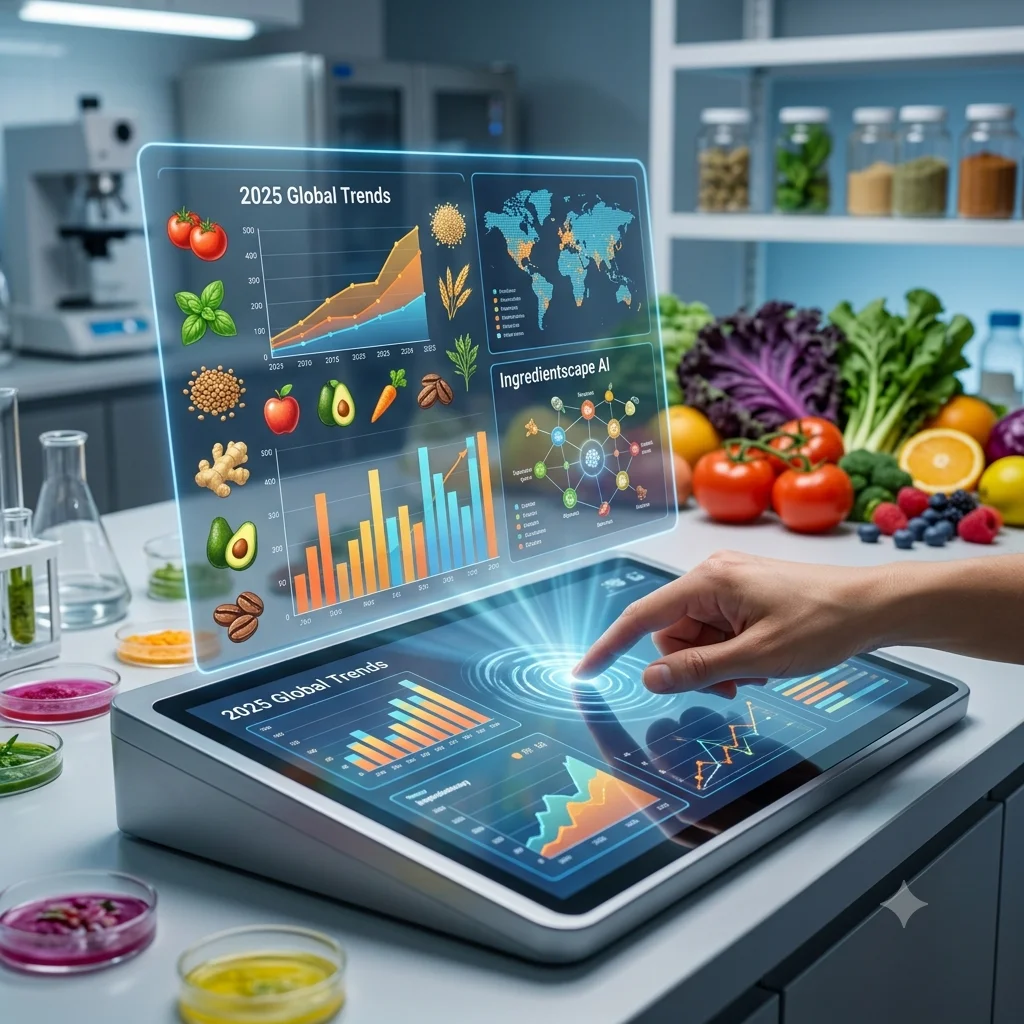
[IMAGE: A futuristic digital dashboard displaying colorful data graphs and ingredient icons, with a hand touching a holographic screen showing ‘2025 Global Trends’ and ‘Ingredientscape AI’, background of a modern laboratory and fresh produce]