Beyond the Buzz: How AI, Sustainability, and Trust Are Redefining the Food
``markdownAI, Sustainability, and Trust: Redefining the Food and Beverage Industry
[IMAGE: A network diagram showing interconnected nodes labeled AI, Sustainability, Traceability, Regulation, and Transparency, with arrows indicating feedback loops.]
Introduction: The Interlocking Architecture of Food Innovation
The global food and beverage industry is no longer navigating a single disruption. It faces a convergence of technological leaps, tightening regulatory frameworks, and a fundamental shift in consumer expectations that together create what the Institute of Food Technologists (IFT) calls a new operational reality. In its latest analysis, IFT identifies five innovation trends that are not isolated phenomena but mutually reinforcing forces: the integration of artificial intelligence, the scaling of sustainable systems, the digitization of traceability, tougher regulation of ultra-processed foods, and the imperative for radical transparency.
These trends are reshaping supply chains, business models, and even the meaning of “trust” in ways that go far beyond marketing buzzwords. The core question for industry leaders is no longer whether to adapt, but how these forces interact to create new risks and opportunities. Drawing on IFT’s data-driven insights, this article unpacks the hidden patterns behind the disruption—revealing an economic logic where governance, partnerships, and infrastructure investment become the new competitive differentiators.
1. AI from Experimental to Essential: The Governance Imperative
[IMAGE: A dashboard screen showing AI-driven supply chain optimization with real-time data flows, alongside a human operator reviewing ethical guidelines.]
Artificial intelligence has moved out of pilot projects and into the operational core of food companies. IFT notes that by 2026, platforms like CoDeveloper are expected to accelerate AI’s role in real-time supply chain decisions, personalized nutrition, and product development. Algorithms now predict demand fluctuations with unprecedented accuracy, optimize formulation costs, and even generate novel flavor profiles. Yet the real breakthrough is not technological—it is organizational.
Scaling AI requires cross-functional alignment that many companies lack. Governance frameworks for data privacy, algorithmic bias, and ethical use are no longer optional. IFT emphasizes that change management and workforce training must accompany every AI deployment, or the technology risks becoming a liability. The hidden economic logic here is profound: AI adoption creates a new class of innovation gatekeepers. Companies that master governance will build a competitive moat, while laggards face systemic risk—from regulatory penalties to brand damage when algorithms make biased or opaque decisions.
For example, the ability to trace an AI-recommended supplier change back to auditable data is becoming a prerequisite for retailers and regulators. Those who treat AI as a black box will soon find themselves locked out of premium supply chains.
2. Scaling Sustainability: Incentives Over Ideals
[IMAGE: A visual showing a supply chain loop with icons for waste reduction, renewable energy, and cross-sector partnerships.]
Sustainability in food systems has long been hamstrung by high upfront costs, slow adoption rates, regulatory fragmentation, and geopolitical tensions. IFT’s analysis is clear: these hurdles are real, but the most promising path forward relies on incentives rather than moral appeals. Progress is emerging from stronger financial incentives, cross-sector partnerships, and targeted infrastructure investment.
The focus areas include food-waste reduction through blockchain-enabled redistribution networks, consumer education campaigns that bridge the intention-action gap, aligned policy frameworks across jurisdictions, and expanded research funding for alternative proteins and regenerative agriculture. IFT highlights that companies participating in shared infrastructure—such as regional composting facilities or joint logistics hubs—can cut costs by 20–30% while meeting regulatory mandates.
The deep insight: sustainability is shifting from a moral imperative to an economic one. Fragmented supply chains that once seemed cost-efficient now produce hidden risks: carbon taxes, water scarcity penalties, and consumer backlash. Companies that invest in harmonized policy engagement and shared infrastructure can reduce fragmentation and unlock new revenue streams. For instance, a beverage manufacturer that partners with a local farm to process organic waste into compost creates a circular revenue loop while improving its ESG score.
3. Digital Traceability: The Backbone of Trust
[IMAGE: A holographic ingredient label floating above a package, with a QR code scanning interface and a blockchain verification certificate visible on a tablet.]
Consumer trust hinges on knowing where food comes from, how it was processed, and whether claims match reality. IFT’s research shows that digital traceability—powered by blockchain, IoT sensors, and cloud-based platforms—is becoming the operational backbone of that trust. It is no longer a nice-to-have; retailers like Walmart and Carrefour already require upstream traceability for high-risk categories.
The trend goes beyond food safety recalls. Modern traceability systems enable real-time visibility into every node of the supply chain, from a farmer’s irrigation data to a cold-chain temperature log at a distribution center. This data fuels AI models that predict spoilage, optimize inventory, and verify sustainability claims. More importantly, it allows companies to prove ethical sourcing to increasingly skeptical consumers.
IFT notes that the challenge lies in interoperability and data standardization. A single global standard remains elusive, but early movers are building private consortiums that set de facto rules. The actionable insight: companies that invest in digital traceability now will be able to charge a premium for verifiable claims (e.g., “carbon-neutral chocolate” or “slave-free shrimp”), while those that delay will be forced into reactive compliance at higher cost.
4. Tighter Regulation of Ultra-Processed Foods: Reformulation as Strategy
[IMAGE: A scientist in a lab coat analyzing a food sample with a digital overlay showing nutritional metrics and reformulation options.]
Governments worldwide are tightening regulations around ultra-processed foods (UPFs). Chile, Mexico, Brazil, and several European nations have already implemented front-of-pack warning labels, taxes, and marketing restrictions. The UK and Canada are following suit. IFT’s analysis reveals that this regulatory surge is not a passing trend—it reflects a structural shift in public health policy with direct economic consequences.
For food manufacturers, the response cannot be defensive. Reformulation is no longer a risk-mitigation tactic; it is a strategic opportunity. Companies that proactively reduce added sugars, sodium, and artificial additives can capture the growing “clean label” market segment. IFT highlights successful examples where reformulation led to double-digit sales growth, especially when paired with transparent communication.
The hidden challenge lies in maintaining taste and shelf stability. That is where AI-driven product development becomes critical. By modeling ingredient interactions at scale, platforms like CoDeveloper help companies achieve better-for-you products without compromising sensory quality. The insight: regulation is not a drag on innovation—it is a catalyst for it. Companies that embed regulatory foresight into their R&D pipeline will outpace competitors who wait for mandates.
5. Transparency as the Ultimate Asset
[IMAGE: A holographic ingredient label floating above a package, with a QR code scanning interface and a blockchain verification certificate visible on a tablet.]
The fifth trend loops back to the first four: transparency is the connective tissue linking AI governance, sustainability, traceability, and regulatory compliance. IFT defines transparency broadly—not just ingredient lists, but a willingness to share data, admit mistakes, and invite third-party verification. In an era of fact-checked consumers and viral reputational crises, opacity is a liability.
Research cited by IFT shows that consumers now demand provenance information for 73% of their food purchases. Yet transparency must be backed by verifiable systems. A brand can claim “sustainable sourcing” only if it can prove it with auditable data. This is where digital traceability meets AI: blockchain records create immutable proof, while algorithms can identify discrepancies that human auditors miss.
The deeper economic logic is that transparency builds trust, and trust reduces transaction costs. Suppliers who are transparent face fewer audits, retailers who are transparent command higher shelf placement, and brands who are transparent enjoy lower customer acquisition costs. IFT predicts that within five years, companies without digital transparency infrastructure will be functionally invisible to both regulators and premium consumers.
Conclusion: The New Playbook for Food Industry Leaders
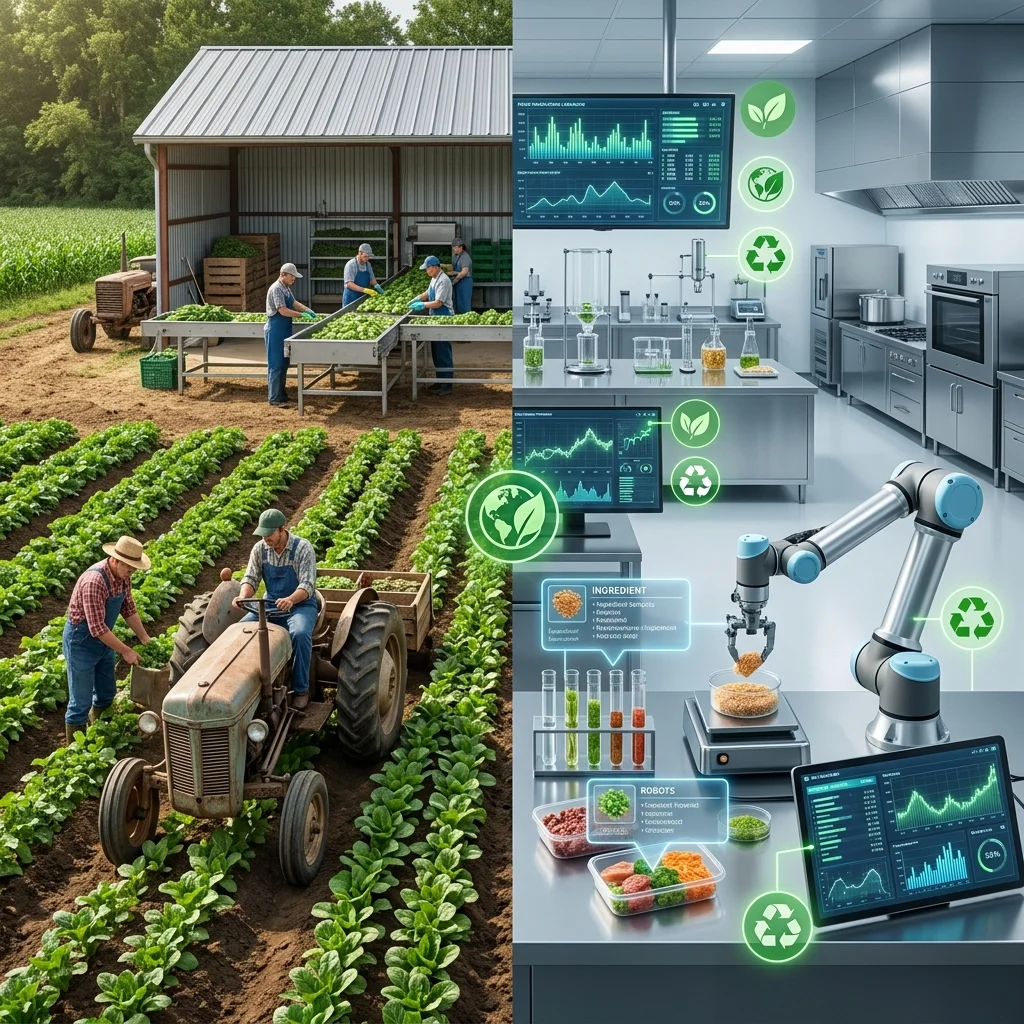
[IMAGE: A futuristic kitchen lab with robotic arms, digital screens showing real-time data, holographic labels, and green sustainability icons like leaves and recycling arrows. No text, no watermark, photorealistic style, 16:9 aspect ratio.]
The five trends—AI integration, sustainable scaling, digital traceability, UPF regulation, and transparency—are not separate challenges. They form an interlocking architecture that demands a cohesive response. IFT’s analysis reveals a hidden pattern: each trend amplifies the others. AI enables better traceability, which supports transparency, which validates sustainability claims, which helps companies navigate regulations, which in turn requires AI-driven reformulation.
For industry leaders, the implications are clear. The era of fragmented, reactive innovation is over. The new playbook requires systemic investment in three areas: governance (to manage AI and data ethics), partnerships (to scale sustainability and traceability infrastructure), and transparency (to convert verifiable claims into market value). Companies that embrace this interconnected logic will not only survive the disruption—they will define the next decade of food and beverage.
The buzzwords of yesterday—AI, sustainability, trust—are now the operational realities of tomorrow. The question is no longer what they mean, but how quickly leaders can build the architecture to act on them.
``